Monday, February 11, 2019

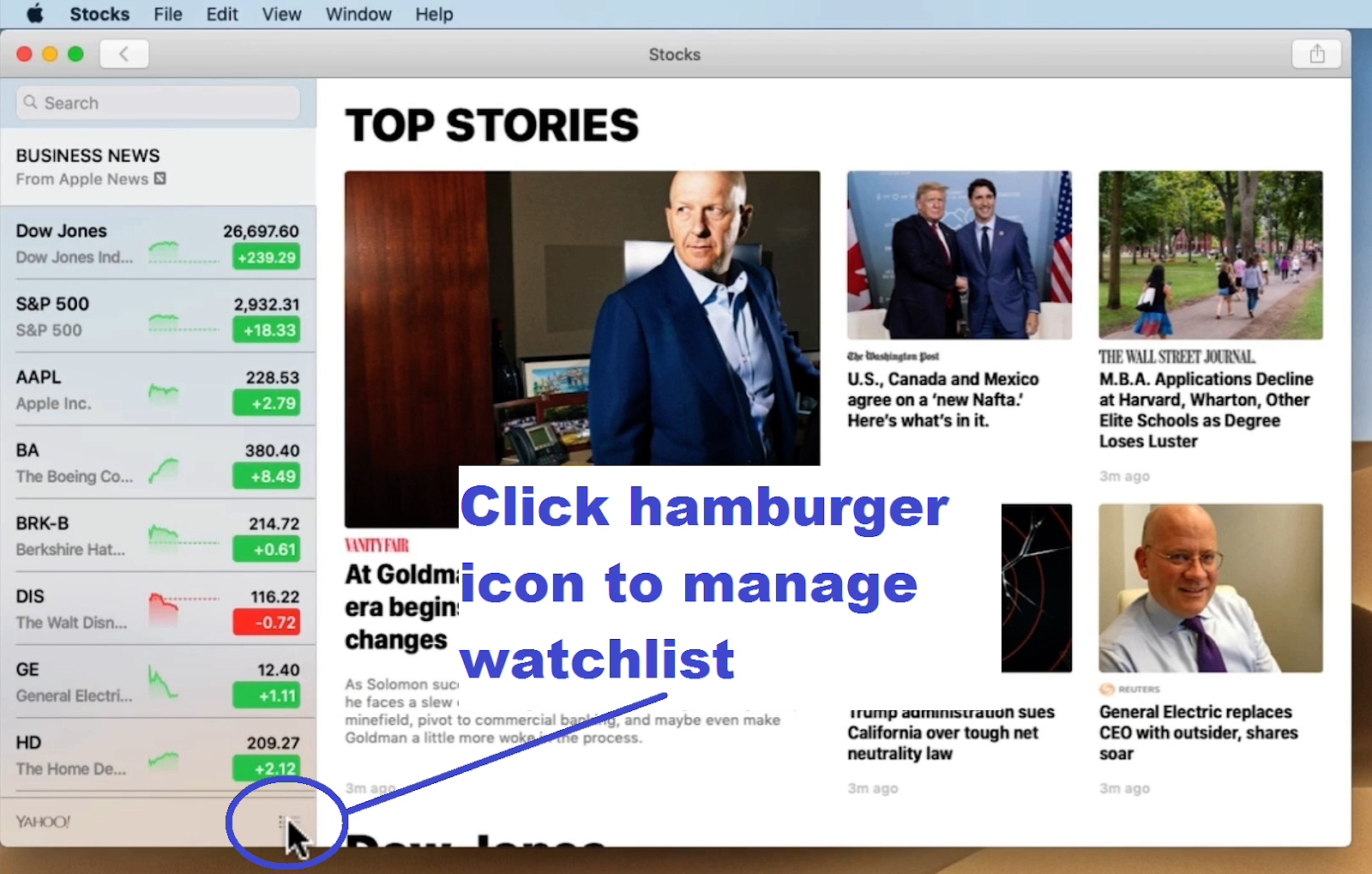
How to Read a Stock Quote on MacOS

Please feel free to zoom in your browser to the make the images larger. Oh yeah, and the following information can be extrapolated to cover other mobile stock tracker apps:


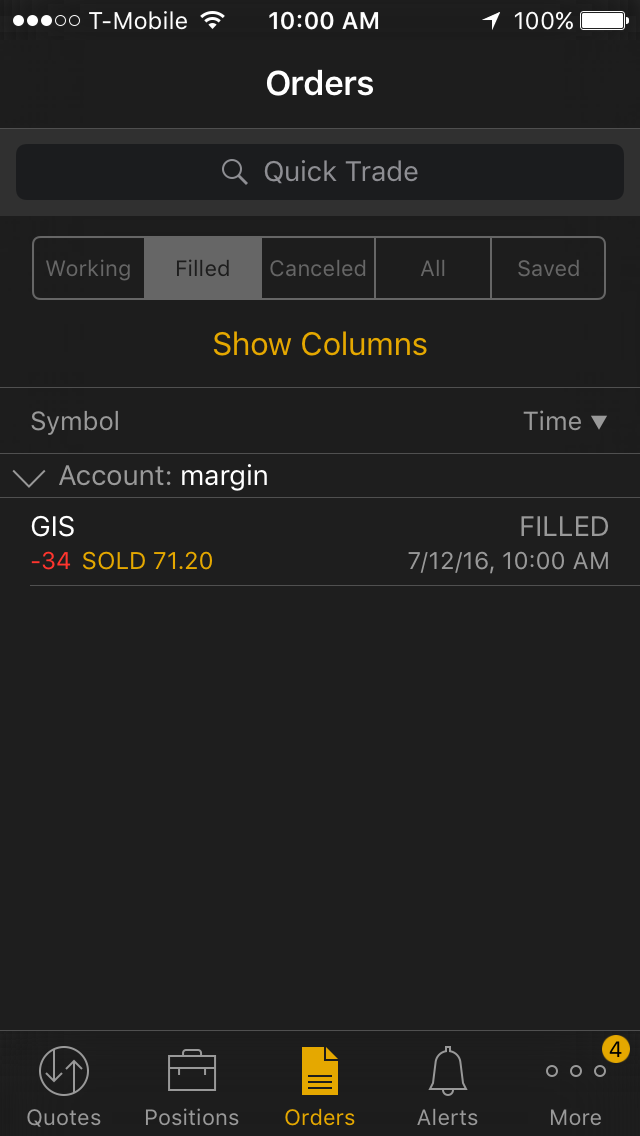
How to Read a Stock Quote on an iPhone (iOS 12 Remix)

Please feel free to zoom in your browser to the make the images larger. Oh yeah, and the following information can be extrapolated to cover other mobile stock tracker apps:


Wednesday, March 22, 2017

The Paper Trade Part 9


10/10/16


October 10th 2016 I bought my first shares of MELI. I bought the equivalent amount for the VOO and for the VTI per usual. Also, I bought additional shares of LEG.


10/14/16


October 14th 2016 I bought additional shares of MELI. I bought the equivalent amount for the VOO and for the VTI per usual. 


11/7/16


The profits (closed position) I had taken on November 7th 2016 $JPM was 14.5%. In simple terms without taking into account dividends and not taking into account weight of positions since the beginning of The Paper Trade Series ...aka assuming all things equal: 14.5%JPM 16%GIS, 16%CSCO, 16%WMT 16%SBUX -19%GNC = 9.91% Capital Gains on the sidelines which puts me just above my benchmarks of VTI and VOO on 11/7/16. 

However, I still have $APPL, $LEG and $MELI in the portfolio and I waiting/sticking with those stocks until they can be included to get me above the VTI and VOO. 


12/8/16


I bought additional shares of $MELI.

Thursday, August 11, 2016

The Paper Trade Part 8


Late April I decided to add new positions in $LEG and $GIS.


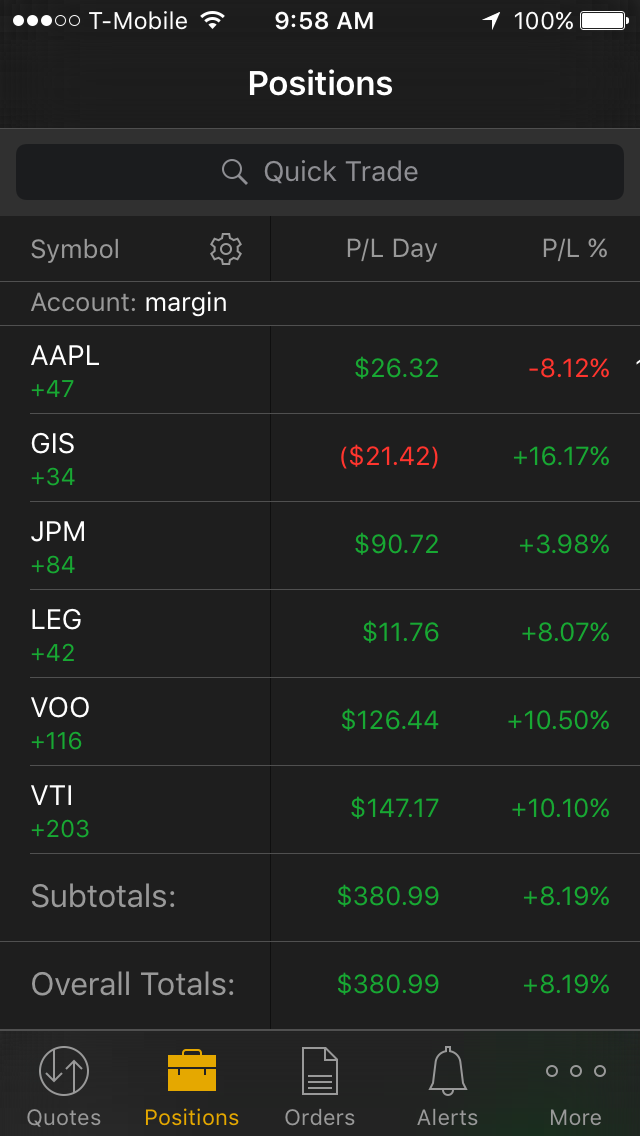
From late April until Mid-July I gained 16% on $GIS and I gained 8% on $LEG. $AAPL was still a struggle during Mid-July, but I have a slight break over even as of Mid-August. 


The profits I had taken from July on $GIS was 16%. In simple terms without taking into account dividends and not taking into account weight of positions since the beginning of The Paper Trade Series ...aka assuming all things equal: 16%GIS, 16%CSCO, 16%WMT 16%SBUX -19%GNC = 7.9% Capital Gains on the sidelines which puts me just below my benchmarks of VTI and VOO. 

My ultimate goal is to outpace the broad indices. I will have to be patient on waiting for $AAPL, $JPM, and $LEG to take off and I may have to add a new position in another corporation to reach my goal sooner at a faster pace, but only if the proper opportunity presents itself. Discipline...Discipline... Discipline. 

Saturday, June 4, 2016

Inbox Dollars is Legit (but not worth the time)


Inbox Dollars as a simple source of extra money in terms of active participation is a waste of time. It took me from 12/28/15-6/4/16 to earn $37. Anything online that is active (clicking emails, surveys, watching videos, etc) should pay you at least 10-cents per minute (The M-turk decent average, but maybe I'll explain M-turk in a futer blog post) . Clicking for the next video, emails, surveys etc is considered being active. However, outside of emails and downloading apps (1 time limit) you cannot actively earn at least 10-cents per minute.


Here are the means of my earnings:


Video earnings have a low return (10-cents for watch 100 15-30 seconds videos) for having to actively select the next video:


Videos, search, downloading apps, emails, & surveys are the primary vehicles to make money without having to sign up with an advertising partner for goods or services. However, surveys can act strange in which you could waste 10-minutes...and then are told you don't qualify for the survey. If you don't mind signing-up with different advertising partners for their goods or services it may be worth your time to earn money passively with Inbox Dollars. 

The cash out minimum is $30, but there is a $3 processing fee. That fee can be waived on first cash-out if you attempt to cash-out at $30 and then inbox Dollars gives you 30 days to reach $40...and therefore you don't get hit with a processing fee. But as I said earlier, I cashed out at $37.


Anyways, once you cash out you need to remain active everyday by checking a paid email or watching a video until the check comes in the mail or a gift card is credited.


My time is better doing something else for active money. I plan to stick with Perk as a money earning app(s) as it is passive money that does not take my time away from engaging in more productive methods of earning money online.

Sunday, May 29, 2016

What is a Money Market Account?


"A money market account is like your basic savings account’s more mature sibling. If you’re looking for a safe place to deposit and earn better interest on a large chunk of money, it might be worth consideration.

Here’s a look at what money market accounts are, how they differ from regular savings accounts and when it makes sense to own one.


What is a money market account?
A money market account is a type of savings account, with the same protections and generally a slightly higher interest rate. The trade-off? There’s usually a higher minimum balance requirement.

Some money market accounts also have limited check-writing and debit card features. But because these are a type of savings account, they fall under the Federal Reserve’s Regulation D, which limits the number of so-called convenient transactions — including checks, debit card swipes and online transfers — you can make to just six per month.

These are different from money market funds, which are investments that can lose value if the market falls. Money market accounts, on the other hand, are backed by the Federal Deposit Insurance Corporation (at banks) and the National Credit Union Administration (at credit unions), up to $250,000 per depositor.


When should you consider one?
Don’t expect to see quick gains on any of the four primary types of bank accounts: checking, savings, money market and CDs. Other investment options are better suited to that end, although not everyone feels comfortable with the volatility of the stock market.

The situation where a money market account is your best option is fairly specific. It’s a good choice if you want:


  • The safety of a bank or credit union.
  • A higher interest rate.
  • Access to funds in a pinch.
  • The ability to write a few checks.
  • If any of those aren’t true (and sometimes even then), you can find better alternatives elsewhere.


For example, if you want growth but greater access to your money, you may be better off opening an interest-bearing checking account. If you don’t care about writing checks, you can find comparable or better rates with some high-yield online savings accounts. And if you just want the bank account with the highest return and can afford to set this money aside for months or years, try a CD.

You could use a a money market account for an emergency fund. Like a basic savings account, it’s separate from your daily use, but the money market account might grow a bit faster and you can write a check from it to cover whatever surprise arises. "


https://www.nerdwallet.com/blog/banking/faq-money-market-account/ )
https://www.nerdwallet.com/blog/author/mburnette/ )

Friday, May 13, 2016

Macroeconomics vs Microeconomics


"Microeconomics is generally the study of individuals and business decisions, macroeconomics looks at higher up country and government decisions.

Macroeconomics and microeconomics, and their wide array of underlying concepts, have been the subject of a great deal of writings. The field of study is vast; here is a brief summary of what each covers:


Microeconomics
Microeconomics is the study of decisions that people and businesses make regarding the allocation of resources and prices of goods and services. This means also taking into account taxes and regulations created by governments. Microeconomics focuses on supply and demand and other forces that determine the price levels seen in the economy. For example, microeconomics would look at how a specific company could maximize its production and capacity so it could lower prices and better compete in its industry. (Find out more about microeconomics in How does government policy impact microeconomics?

Microeconomics' rules flow from a set of compatible laws and theorems, rather than beginning with empirical study.


Macroeconomics
Macroeconomics, on the other hand, is the field of economics that studies the behavior of the economy as a whole and not just on specific companies, but entire industries and economies. This looks at economy-wide phenomena, such as Gross National Product (GDP) and how it is affected by changes in unemployment, national income, rate of growth, and price levels. For example, macroeconomics would look at how an increase/decrease in net exports would affect a nation's capital account or how GDP would be affected by unemployment rate. (To keep reading on this subject, see Macroeconomic Analysis.)

John Maynard Keynes is often credited with founding macroeconomics. He started the use of monetary aggregates to study broad phenomena; some economists reject his theory and many of those who use it disagree about how to interpret it.

While these two studies of economics appear to be different, they are actually interdependent and complement one another since there are many overlapping issues between the two fields. For example, increased inflation (macro effect) would cause the price of raw materials to increase for companies and in turn affect the end product's price charged to the public.

The bottom line is that microeconomics takes a bottoms-up approach to analyzing the economy while macroeconomics takes a top-down approach. Microeconomics tries to understand human choices and resource allocation, and macroeconomics tries to answer such questions as "What should the rate of inflation be?" or "What stimulates economic growth?"

Regardless, both micro- and macroeconomics provide fundamental tools for any finance professional and should be studied together in order to fully understand how companies operate and earn revenues and thus, how an entire economy is managed and sustained."


Wednesday, May 11, 2016

S&P 500 defined.


"WHAT IT IS:

The S&P 500 Index is a diverse index that includes 500 American companies that represent over 70% of the total market capitalization of the U.S. stock market. 


HOW IT WORKS (EXAMPLE):

First developed in 1923, the index initially contained 233 stocks. However, in 1957 it was modified to include a diversified basket of 500 common stocks.

The S&P 500 is not comprised of simply the 500 largest U.S. stocks. Instead, it consists primarily of leading companies from a wide variety of different economic sectors. The index started with 23 identified sectors, but today contains over 100 unique sectors. Most analysts choose to use the S&P as their preferred benchmark index thanks to its diversified sector coverage as well as its market value weighting. Because the index is weighted by market capitalization, the largest firms have the greatest impact on the S&P's value.


WHY IT MATTERS:

The S&P 500 index is probably the most commonly referenced U.S. equity benchmark. Many regard it as the single best way to track the overall performance of the largest and most dominant American companies.

Because of the index's high market cap requirements, the S&P 500 does reflect the performance of some of the smaller, but faster growing, companies on the market. A number of different mutual funds track the performance of the S&P 500. However, many investors find that the most convenient and cost-effective way to trade this index is to purchase a SPDR (Spider). A spider is an exchange-traded fund (ETF) that tracks the S&P 500. It has an extremely low expense ratio and can easily be bought or sold on the open market just like a regular common stock."


Friday, May 6, 2016

Total Stock Index Defined.


"DEFINITION of 'Total Stock Fund'
A mutual fund or ETF that seeks to replicate the broad market by holding the stock of every security that trades on a certain exchange, invests in a certain country, or passes basic thresholds of size (market cap) or trading volume. Total stock funds, also called total stock market index funds or total market funds, may track a broad index such as the Wilshire 5000, Russell 2000 or MSCI U.S. Broad Market.


BREAKING DOWN 'Total Stock Fund'
These super-broad index funds tend to have less volatility than even large indexes like the S&P 500 just because they hold so many companies' stock. Most total stock funds will have portfolio weightings based in some way on market cap, but they are not necessarily just market-cap weighted, like the S&P 500 is. 

Total stock funds may not capture a full 100% of the market capitalization of their target market (such as the whole United States or all small-cap stocks), but they are usually able to capture 95% or more by owning the first few thousand stocks in order of market capitalization.

One of the largest and oldest total stock funds is the Vanguard Total Stock Market Index Fund, which has nearly $100 billion in assets and owns the 1,300 largest companies that trade on the NYSE, AMEX and Nasdaq."


Tuesday, May 3, 2016

What is Market cap?


"What is 'Market Capitalization'
Market capitalization is the total dollar market value of all of a company's outstanding shares. Market capitalization is calculated by multiplying a company's shares outstanding by the current market price of one share. The investment community uses this figure to determine a company's size, as opposed to sales or total asset figures.

Frequently referred to as "market cap."


BREAKING DOWN 'Market Capitalization'
If a company has 35 million shares outstanding, each with a market value of $100, the company's market capitalization is $3.5 billion (35,000,000 x $100 per share).

Company size is a basic determinant of asset allocation and risk-return parameters for stocks and stock mutual funds. The term should not be confused with a company's "capitalization," which is a financial statement term that refers to the sum of a company's shareholders' equity plus long-term debt.

The stocks of large, medium and small companies are referred to as large-cap, mid-cap, and small-cap, respectively. Investment professionals differ on their exact definitions, but the current approximate categories of market capitalization are:


Mega Cap - Market cap of $200 billion and greater
Large Cap - $10 billion and greater
Mid Cap - $2 billion to $10 billion
Small Cap - $300 million to $2 billion
Micro Cap - $50 million to $300 million
Nano Cap - Under $50 million "


( http://www.investopedia.com/terms/m/marketcapitalization.asp#ixzz47eIkzLSH )
( http://www.investopedia.com/articles/analyst/010502.asp#ixzz47eJeCpeh )

Saturday, April 30, 2016

What is Fiscal Policy?


"What is 'Fiscal Policy'
Government spending policies that influence macroeconomic conditions. Through fiscal policy, regulators attempt to improve unemployment rates, control inflation, stabilize business cycles and influence interest rates in an effort to control the economy. Fiscal policy is largely based on the ideas of British economist John Maynard Keynes (1883–1946), who believed governments could change economic performance by adjusting tax rates and government spending.


BREAKING DOWN 'Fiscal Policy'
To illustrate how the government could try to use fiscal policy to affect the economy, consider an economy that’s experiencing a recession. The government might lower tax rates to try to fuel economic growth. If people are paying less in taxes, they have more money to spend or invest. Increased consumer spending or investment could improve economic growth. Regulators don’t want to see too great of a spending increase though, as this could increase inflation.

Another possibility is that the government might decide to increase its own spending – say, by building more highways. The idea is that the additional government spending creates jobs and lowers the unemployment rate. Some economists, however, dispute the notion that governments can create jobs, because government obtains all of its money from taxation – in other words, from the productive activities of the private sector.

One of the many problems with fiscal policy is that it tends to affect particular groups disproportionately. A tax decrease might not be applied to taxpayers at all income levels, or some groups might see larger decreases than others. Likewise, an increase in government spending will have the biggest influence on the group that is receiving that spending, which in the case of highway spending would be construction workers.

Fiscal policy and monetary policy are two major drivers of a nation’s economic performance. Through monetary policy, a country’s central bank influences the money supply. Regulators use both policies to try to boost a flagging economy, maintain a strong economy or cool off an overheated economy. "


( http://www.investopedia.com/terms/f/fiscalpolicy.asp#ixzz47JyMeqHR )

Tuesday, April 26, 2016

Capitalism and Free Enterprise are not quite the same.


" Capitalism and free enterprise are often seen as synonymous. In truth, they are closely related yet distinct terms with overlapping features. It is possible to have a capitalist economy without complete free enterprise, and possible to have a free market without capitalism.

Any economy is capitalist as long as the factors of production are controlled by private individuals. A free enterprise system has many more necessary conditions and more meaningful implications about social arrangements and government policy.


Capitalism and Production
Capitalism primarily refers to production and property. Under capitalism, the factors of production and their economic rent belong to private individuals or companies. This is distinct from socialism and communism, where the state controls and deploys the factors of production.

The term "capitalism" became famous after Karl Marx used it to deride the profit-seeking employers in Western Europe. As time passed, the connotation of capitalism changed from meaning exploitative to meaning productive.

However, a capitalist system can still be regulated by government laws and the profits of capitalist endeavors can still be taxed heavily. In this sense, nearly all Americans support capitalism, but not all support a free enterprise system.


Free Enterprise and Wealth Exchange
"Free enterprise" can roughly be translated to mean economic exchanges free of coercive government influence. Although unlikely, it is possible to conceive of a system where voluntary individuals always trade in a way that is not capitalistic.

Private property rights still exist in a free enterprise system, although private property may be voluntarily treated as communal without government mandate. Many Native American tribes existed with elements of these arrangements.

Free enterprise is a theory within political economy. If accumulation, ownership and profiting from capital is the central principle of capitalism, then freedom from state coercion is the central principle of free enterprise. "


( http://www.investopedia.com/ask/answers/033015/what-difference-between-free-enterprise-and-capitalism.asp#ixzz46wpZHGFj )
http://www.investopedia.com/contributors/53893/ )